Fall Recruiting Starts Before Fall: How Students Can Use Summer to Get Ahead
Most families assume fall recruiting starts in September. For many competitive opportunities, the preparation needs to start well before students return to campus. In some fields, applications and employer activity may already be underway by late summer.
Here’s what that means for your student this summer, and how you can help without taking over.
The reality most families miss
By the time students return to campus, many employers are already moving. Applications may be open. Career fairs may be scheduled. Information sessions may be underway. Interviews may be approaching.
And students are suddenly trying to manage classes, clubs, social life, and career decisions all at once.
This is especially true in fields like finance, consulting, technology, and some structured internship or rotational programs, where recruiting timelines can start earlier than most families expect. Career centers at schools like Cornell note that some recruiting timelines begin as early as the summer, well before the fall semester is fully underway.
But the pattern extends broadly. Students who wait until they feel “ready” in September often find they are already behind.
The students who enter fall with confidence are rarely the ones who figured everything out overnight. They are the ones who did the invisible work in June, July, and August.
They clarified what they were targeting. They updated their materials. They built a little evidence. They started career conversations before everyone else was rushing.
In other words, fall recruiting is often a summer project in disguise.
Why the fall rush is so hard to manage
When students arrive back on campus unprepared, the combination hits fast: new classes, club commitments, career fairs, employer information sessions, resume deadlines, and interview invitations all at once.
Without a structure, students often rush. They apply broadly without knowing why. They use a resume that has not been updated since spring. They skip networking because they do not know what to say. They chase roles that sound impressive but do not fit.
This is not laziness. It is the absence of a plan.
That plan is much easier to build in the summer than in the middle of a busy semester.
What summer preparation actually means
When parents hear “career preparation,” they often assume it means students should spend all summer applying to jobs.
That is not the point.
Summer preparation is about getting ready to apply well.
Before fall pressure builds, a prepared student can answer:
What kinds of roles am I targeting?
What skills do those roles require?
What experience do I already have that connects?
Who could I talk to in order to understand this field better?
What do I want to be able to say in an interview by August?
A student who has not answered those questions will often use the same generic resume for everything, applying to marketing, finance, consulting, and nonprofit roles with no clear thread.
Employers do not expect students to have everything figured out. But they do expect students to explain why they are interested, what they bring, and how their experience connects.
That takes preparation.
The three things that matter most
1. Direction before applications
The first task is not to apply everywhere. It is to narrow the field.
Students do not need one perfect answer. They need enough direction to make better choices. A useful starting point is choosing two or three possible role areas to explore, then reading eight to ten actual job descriptions in each area.
What responsibilities show up repeatedly? What skills are mentioned again and again? What tools or technical abilities appear?
A student who does this exercise can move from “I need an internship” to “I’m targeting marketing roles, and I keep seeing content creation, campaign analysis, and Excel. This summer I should build proof in those areas.”
That is a much more effective foundation.
2. Materials that are ready before deadlines hit
Many students wait until an application is due to update their resume. By then, the posting is already open and the window may be short.
Summer is the right time to update the resume, LinkedIn profile, and personal pitch. More importantly, it is the right time to learn how to talk about experience.
Students often undersell themselves not because their experience is weak, but because they describe it too generally.
“Helped customers.”
“Worked on a group project.”
“Managed social media.”
Those phrases may be true, but they are thin.
The stronger version explains what the student actually did, what problem they helped solve, and what changed because of their effort. A summer job, a volunteer role, a class project, or a campus leadership role can all become meaningful evidence when the student learns to translate it.
That translation is a career skill. And it is easier to practice in June than under deadline pressure in October.
3. Proof that goes beyond interest
Employers are not only looking for interest. They are looking for evidence.
Evidence does not have to come from a formal internship. It can come from a summer job described with precision, a course that led to a real project, a leadership role in a student organization, a case competition, a writing sample, a research summary, or anything else that gives the student something concrete to discuss.
In fields with earlier or more structured recruiting timelines, deadlines can catch students off guard. But across industries, the principle is the same: the student with something concrete to point to is in a stronger position than the student with only intentions.
The right question for your student this summer:
What can I create, learn, improve, or document that would give me something stronger to talk about in the fall?
That question turns a vague summer into visible progress.
A simple summer plan
This does not need to be complicated. It needs to be intentional.
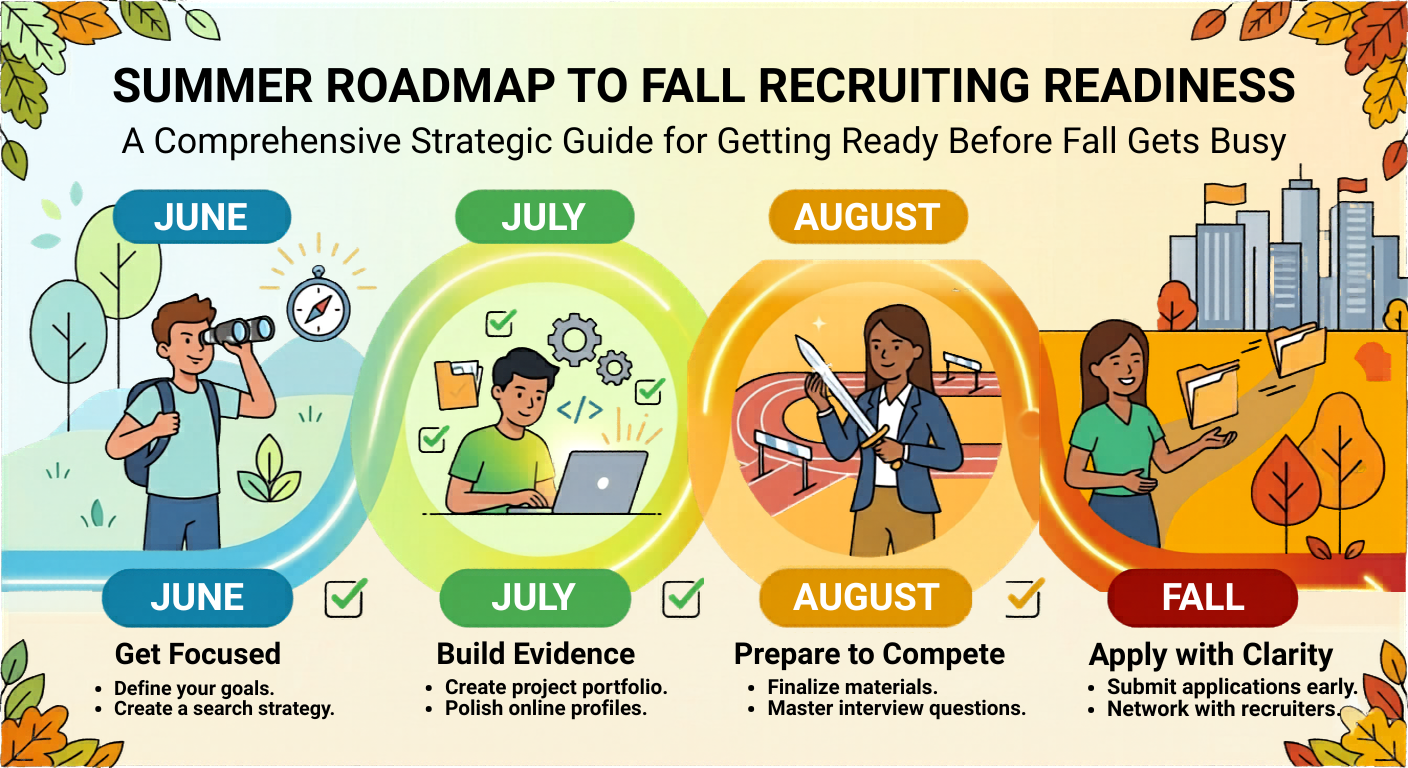
June: Get focused. Choose two or three role areas. Read job descriptions and identify the skills and keywords that appear most. Update the resume with recent experience. Clean up the LinkedIn profile. Make a preliminary list of target companies. Reach out to a few alumni, older students, or family contacts for short career conversations.
The goal by the end of June is not certainty. It is focus.
July: Build evidence. Complete a relevant project. Take a targeted course and apply the learning. Continue a summer job or volunteer role with more intention, tracking accomplishments and responsibilities with specific examples. Practice explaining experience out loud.
The goal by the end of July is to have stronger material to discuss in resumes, interviews, and networking conversations.
August: Prepare to compete. Finalize the resume. Prepare a clear personal pitch. Build a target application list and set up job alerts. Research fall career fairs and employer events. Practice interview stories. Create a weekly recruiting routine before classes begin.
The goal by the end of August is not to be finished. It is to enter fall with momentum instead of panic.
How parents can help without taking over
Your student needs to own this work. They need to make decisions, send messages, write their own resume, practice their own pitch, and manage the process.
A good resource should help them take the next step, not give parents a new set of tasks to manage.
But parents can play a helpful role. The key is creating structure and accountability, not dependence.
Useful questions to ask:
“What kinds of roles are you thinking about for next summer or after graduation?”
“What would make you feel more prepared before fall recruiting starts?”
“What is one career step you want to take this week?”
“What do you want to be able to say about your summer by the end of August?”
Questions that tend to backfire:
“Have you applied yet?”
“Your friend already has something lined up.”
“Why haven’t you done more?”
The goal is to lower defensiveness and increase ownership. Students engage more when the conversation feels practical and forward-looking, not comparative or shaming.
A few things to avoid: do not write the resume for your student. Do not send networking messages on their behalf. Do not apply to jobs for them. Do not assume that a prestigious-sounding path is the right one. And do not turn every summer conversation into a career check-in.
Pressure may create movement. It does not always create clarity.
The better goal is to help your student build a rhythm they can actually sustain.
The bottom line
Fall recruiting starts before fall.
That does not mean students need to sacrifice their whole summer to the job search. A few focused hours each week can make a real difference.
Students who clarify direction, update their materials, build proof, and start a few career conversations before September enter fall in a stronger position than students who wait. They are not scrambling to catch up. They are working from a plan they have already started.
Some of the most competitive recruiting windows may already be open, or opening quickly, by the time students return to campus. The students who stand out in September are usually the ones who did the quiet preparation in June, July, and August.
I designed The Fall Recruiting Readiness Checklist for students to use directly, with a short parent section on how to support without taking over.
Want a practical tool your student can use to turn summer into a fall recruiting plan? Download The Fall Recruiting Readiness Checklist.
If your student needs more personalized support turning summer into a clear fall recruiting plan, schedule a GradLanding call to explore whether coaching is the right fit.
If another family is wondering when their student should start preparing, feel free to send this their way. The goal is not pressure. It is helping students enter fall with more clarity, structure, and momentum.