Mid-Summer Check-In: Is Your Student Building Proof or Just Staying Busy?
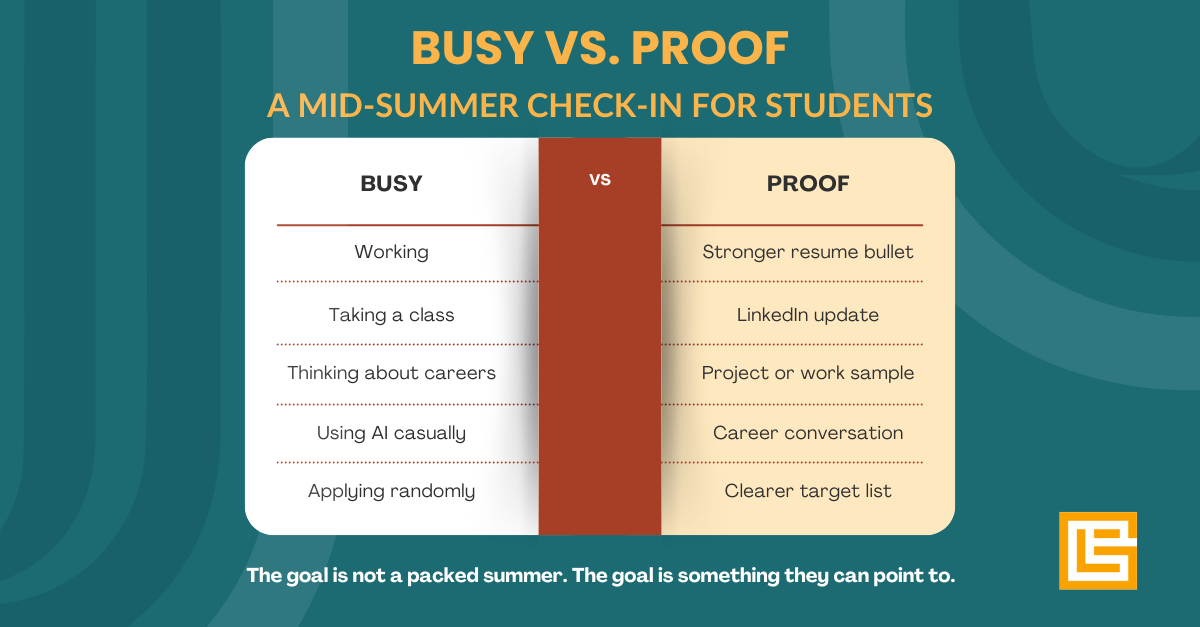
By July, many parents start to wonder whether the summer is actually helping their student move forward.
Maybe your student has an internship, a part-time job, a class, a volunteer role, a family commitment, or a mostly open calendar. Maybe they are working hard. Maybe they are resting after a demanding year. Maybe they are saying they will “get to it later.”
Summer does not need to be packed to be useful. Students do not need every week scheduled, and they do not need to turn every experience into a career move. But by August, they should be able to point to something concrete: a skill they built, a project they completed, a conversation that gave them direction, an updated resume or LinkedIn profile, or a clearer explanation of what they are interested in.
The goal is not busyness. The goal is proof.
What is really happening right now
The early-career market is not closed, but it is more demanding than many students realize. Employers are still hiring interns and new graduates, but they are looking more carefully for evidence. They want students who can explain what they have done, what they learned, how they think, and how their skills connect to the work.
AI is also changing expectations for entry-level talent. Students do not all need to become technical experts, but they do need to show that they can learn new tools, use good judgment, communicate clearly, and adapt as work changes.
That is why summer activities matter. Not because students need to be busy every minute, but because even a simple summer experience can become useful evidence if the student knows how to explain it.
This is where many students fall short. They may be doing useful things, but they are not always translating those experiences into resume language, LinkedIn language, interview stories, or clearer direction.
Busy is not the same as ready
A student can have a full summer and still have very little to say by August.
They can work a part-time job but never identify the skills they are building. They can take a class but never turn it into a project or work sample. They can say they are “interested in business,” “thinking about marketing,” or “open to anything” without getting clearer about what those interests actually mean.
They can also use AI casually without being able to explain how they used it in a thoughtful, practical way. Or they can have a few conversations with adults but never follow up, reflect, or use those conversations to shape a next step.
From the outside, the summer may look active. But if the student cannot explain what they learned, built, practiced, or clarified, the career story still stays fuzzy.
That is the gap parents often feel. The calendar may be full, but the student still does not sound more prepared.
Why students struggle with this
Most students are not lazy. Many simply do not know how to see their own experiences through an employer’s eyes.
A student may say, “I’m just working at a restaurant.” An employer may see communication, reliability, teamwork, customer service, problem-solving, and the ability to stay calm under pressure.
A student may say, “I’m just helping a small business with social media.” An employer may see writing, audience awareness, content planning, brand judgment, consistency, and initiative.
A student may say, “I’m just taking an online course.” An employer will care more if that course leads to something visible, such as a project, analysis, case study, dashboard, writing sample, presentation, or clearer explanation of what the student learned.
The activity matters, but the translation matters just as much. That is what turns a summer experience into proof.
What this means for parents
Parents often notice the lack of direction before students do. You may sense that your student is busy but unfocused, relaxed but drifting, interested in several things but unable to explain any of them clearly.
This is where parents can be helpful, but it is also where it is easy to overstep.
The goal is not to become your student’s project manager. The goal is to ask better questions and help them think more concretely.
Instead of asking, “Have you applied to enough jobs?” you might ask, “What do you want to be able to say you learned, built, or figured out by the end of the summer?”
Instead of saying, “You need to network,” you might ask, “Is there one person you could talk to this month who does work you are curious about?”
Instead of saying, “You need to fix your resume,” you might ask, “If someone asked what you did this summer, what would you want that answer to sound like?”
Those questions keep the conversation focused on ownership rather than pressure.
What students should do next
At this point in the summer, students do not need a complete overhaul. They need a simple proof audit.
They can start by asking themselves a few practical questions:
What have I done so far this summer? What skill is this helping me build? What could I create, document, update, or explain from it? What story could I tell in an interview? What does this experience help me clarify about what I want, or do not want?
If the answers are unclear, that is not a failure. It is useful information. There is still time to add one meaningful layer before August.
That might mean updating one section of a resume, refreshing a LinkedIn headline or About section, completing one small project related to a field of interest, having three career conversations, creating a short writing sample or research brief, or building a starter list of roles, companies, or industries to explore.
One specific proof-building move is more valuable than ten vague intentions.
How parents can help without taking over
Ask your student to choose one thing they want to have by August. Not a complete career plan, and not a long list of tasks. One clear proof point.
That might be a stronger resume section, a small project they can show, a skill they can name, a few people they have spoken with, or a better explanation of what they are looking for.
Then help them make it concrete.
“I want to learn more about marketing” becomes: “I will talk to three people in marketing and compare what I learn about brand, product, and field marketing.”
“I want to get better at AI” becomes: “I will use AI to research one industry, compare five job descriptions, identify common skills, and create a one-page summary.”
“I need to update my resume” becomes: “I will rewrite my summer experience into three bullets that show skills, action, and result.”
“I do not know what I want” becomes: “I will identify three fields I am curious about and have one conversation in each.”
Specific is what turns intention into progress.
A simple action for this week
This week, ask your student one question: “What is one thing you want to be able to point to by the end of the summer?”
Then have them choose one proof-building move. They might update part of their resume, refresh their LinkedIn profile, complete a small project, schedule a few career conversations, or build a starter list of roles and companies to explore.
The point is not to create panic. The point is to avoid arriving in August with a summer full of activity and no clear language to explain it.
By the end of the summer, your student should be able to say something specific: “Here is what I learned.” “Here is what I built.” “Here is what I figured out.” “Here is how I am stronger than I was in May.”
That is proof. And proof is what helps a student move from busy to ready.
If your student has no clear summer plan yet, this is a good time to reset. Start with the GradLanding Fall Recruiting Readiness Checklist. If your student needs more structure, book a GradLanding call to talk through how to turn the rest of summer into clearer direction, stronger language, and something useful to carry into fall.